
The lowdown on rosacea and facial redness
Rosacea
Rosacea is a common condition that affects people in theirs 20’s to 40’s. The extent to which rosacea suffers are affected is often underestimated. A recent survey showed that 76 percent of rosacea patients had low self-confidence and self-esteem, and 41 percent reported that their rosacea had caused them to avoid public contact or cancel social engagements.
Aside from the obvious visual effects, rosacea is known to cause stinging, burning and soreness. Even though effective treatment is available for rosacea, only a small proportion of rosacea sufferers are actually receiving any treatment. Much of this is due to the lack of awareness that treatments are available.
Rosacea has three main variants, and treatment is most effective when it is tailored to the type or types of rosacea present within one individual. Most sufferers have either one or two forms of rosacea present.
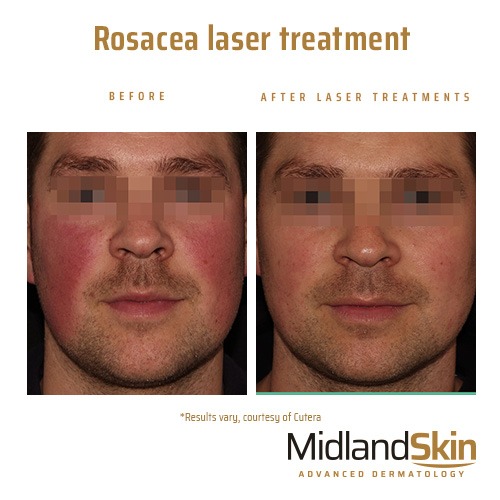
The first form of rosacea, erythemato-telangiectatic rosacea, gives rise to facial redness, broken capillaries, thread veins, and flushing. The skin can feel sore, and even become puffy or swollen. Redness can progressively deepen and lead to significant embarrassment. Flushing can occur in relation to changes in emotions, or from consuming hot drinks, alcohol and spicy foods, though in reality episodes are often spontaneous. This form of rosacea is best treated by light based therapies such as Intense Pulsed Light or IPL. IPL can help reduce both background redness and thread veins. A course of 2 to 6 treatments is normally requried.
The second variant, papulo-pustular rosacea, gives rise to acne like spots and pustules. Spots are most likely to occur over the central face and comedones (blackheads) are absent. This is in contrast to acne vulgaris where spots can be present on the whole face, chest and back and comedones are present. This form of rosacea is best treated by prescription antibiotic and anti-inflammatory therapy.
Both forms of rosacea also respond to a good skin care regime that cuts out potentially irritating factors, and includes anti-inflammatory and anti-oxidant treatments. Sun protection is also thought to be beneficial in reducing the progression of rosacea.
The third variant is known as rhinophyma, and gives rise to an enlarged, bulbous nose from overgrowth and thickening of the glandular tissue in the skin. This form of rosacea can be treated by laser reduction either alone or with retinoid therapy.
The full range of rosacea treatments are available at Midland Skin, Birmingham. Our expert Dermatologists are able to accurately diagnose your condition and give you tailored advice to help control rosacea. To find out more information go to www.midlandskin.co.uk or call 0121 285 4045

It is really difficult to find products that don’t irritate. So far I’ve only had luck with cetaphil. Anything else “sets my face on fire”.
Thanks for the post.