
What is hormonal acne?
Hormonal acne is very common in women after puberty, especially in adulthood. Hormonal acne may be triggered just before, during or after a menstrual period in a predictable way. Hormonal acne resembles usual acne but may cause more deeper nodules and cysts, that last for long periods. Hormonal acne causes spots on the chin and jaw line & also around the mouth. Hormonal acne can also cause acne over the whole face and back.
Why is hormonal acne important?
Hormonal acne does not always respond fully to treatment with acne creams, such as topical retinoids, and antibiotics. In some cases hormonal acne does not even respond well to treatment with Isotretinoin (Isotretinoin/Accutane). Hormonal acne is more likely to come back after a course of Roaccutane (Accutane) has successfully cleared it.
Besides being stubborn to treat, hormonal acne causes redness for prolonged periods, scarring and pigmentation. Some types of hormonal acne cause a large number of comedones to develop especially on the sides of the face – temples, cheeks and jaw line.
Enlarged pores on the nose and cheeks are commonly seen with hormonal acne. Hormonal acne can be really frustrating and cause a reduced quality of life for sufferers.
Hormonal acne can be distinguished from fungal acne on the type of spots and their location. Fungal acne causes smaller spots that are more evenly sized and itchy.
At what age does hormonal acne occur?
Hormonal acne can start in the teenage years and continue in to the 20’s and 30’s. Hormonal acne may also develop for the first time over the age of 20.
Hormonal acne can also develop perimenopause and menopause.
Hormonal acne and birth control pills, mini pill and Mirena coil
Hormonal acne may be triggered for the first time by taking hormonal pills, or from taking any progesterone containing products such as the mini pill or the Mirena coil.
Why do androgens cause hormonal acne?
For the majority of women, hormonal acne occurs because their skin is sensitive to the normal levels of androgens like Testosterone.
Although considered to be a male hormone, it is normal for women to produce small amounts of Testosterone. Testosterone is an important hormone for women as it helps strengthen bones and muscles, provides a healthy libido and regulates the menstrual cycle. Androgens are the name for ‘male’ hormones. Women produce other androgens as well as Testosterone. These are dehydroepiandrosterone sulphate (DHEAS), dehydroepiandrosterone (DHEA), androstenedione (A). These three androgens are not very active by themselves and have to be converted to Testosterone or Dihydrotestosterone first.
Testosterone is produced by the ovaries and the adrenal glands. However, cells in the skin also make Testosterone from DHEAS. Skin cells, especially the cells in the sebaceous glands, also make DHT from Testosterone.
Hormonal acne also occurs when there are conditions in which too many androgens are produced such as Polycystic Ovarian Syndrome.
Are levels of Testosterone and of other androgens raised in hormonal acne?
There is conflicting evidence on this though the majority of studies show that elevated androgen levels are are frequent.
A large study from 2013 showed that of 835 women with hormonal acne, 55% had elevated levels of androgens – DHEA being the one most frequently elevated. A Turkish study from 2017 of 207 women showed 55% of women with acne had elevations in one androgen. Smaller studies from Brazil and Japan have also showed elevated levels of androgens in adult women with acne.
A Czech study from 2000 of 90 women with acne showed that 81% had an elevated level of at least one androgen. The severity of acne did not vary with the degree of elevation however. However a British study from 1989 showed no elevations in androgens in women with acne.
Our clinical impression is that some women do have elevated androgen levels and hormonal acne may be the only sign of this. Other signs include excessive facial and body hair, irregular periods and hair loss. However, a large number of women have normal levels of androgens and it is believed that these women may just be more sensitive to these androgens. This is the reason they get acne.
The bottom line is routine hormone blood tests may be normal in hormonal acne. Hypersensitivity of the skin means that anti-androgen treatment is still important. Also Testosterone and DHT can be produced in the skin and blood tests would not show if too much of these hormones is being produced in the skin in some people.
Why do androgens such as testosterone cause acne?
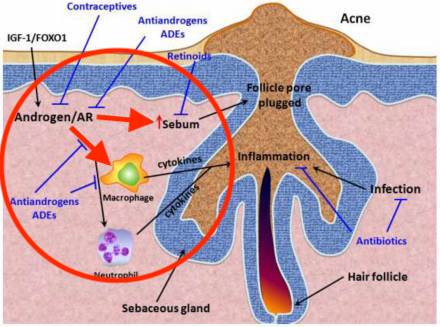
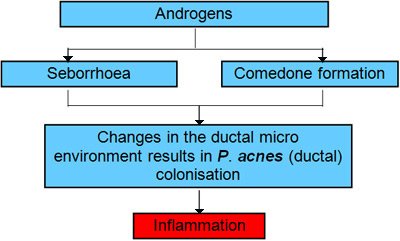
Androgens cause changes in the skin and directly drive inflammation. Here are the three reasons why androgens cause acne:
- The sebaceous glands are very rich in androgen receptors. As soon as androgens meet their receptors, the sebaceous glands produce more sebum. This causes greasiness of the skin and a build up of sebum in the pores. The sebaceous glands are also where the precursors are converted to Testosterone and DHT.
- Androgens may also be important in ‘clogging’ hair follicles and causing comedones to be formed.
- HEA-S is a stimulator of inflammation. It causes T cells (a type of white blood cell) in the skin to produce IL2 and drives inflammation leading to acne spots.
This diagram shows the complex effects of androgens in the skin that cause acne:
Here is a simpler way of looking at how androgens aggravate acne :
Testing androgen and testosterone levels
It is possible to test levels of androgens women by a blood test. Blood tests can be done for Testosterone, DHEA, DHEAS and Androstenedione. Primary care guidelines suggest that:
- Testosterone is tested if Polycystic Ovarian Syndrome is considered because there is oligomenorrhoea (less than 9 periods a year) and hirsuitism
- There is hirsuitism, fertility problems and short stature suggesting a rare condition called congenital adrenal hyperplasia
European and American acne guidelines both support the use of anti-androgen treatment but do not clarify when testing should done.
Our view is that testing for hormones can be important in many people with hormonal acne, and it is something that your Dermatologist will discuss with you at Consultation.
What are the treatments for hormonal acne?
- Combined oral contraceptive pill. Combined pill contain oestrogen and and progesterone. The following progesterones are preferred as they are also anti-androgenic – Drospirenone (Yasmin), Deienogest (Qlaira) and Cyproterone (Dianette – this contains 2mg of Cyproterone). However in some people, the combined oral contraceptive pill or the progesterone only mini pill may cause a flare in acne. For others, there is flare when the pill is stopped which usually means the underlying hormonal acne is active again.
- Spironolactone – this medication blocks androgen receptors
- Cyproterone on day 1 – 10 of the menstrual cycle at higher doses of 50 – 200mg. Cyproterone is a powerful blocker of androgen receptors and can be given with the combined pill, in high doses for 10 days of the cycle. Post-menopausal women do not need to take the combined oral contraceptive pill.
- Metformin – while Metformin is not an anti androgen medication, it may help regulate hormones like IGF-1 which cause acne and ‘cross talk’ with androgens.
Spironolactone is the most common treatment for hormonal acne that is provided by Dermatologists.
What are the benefits of using anti androgen treatments for hormonal acne?
Anti androgen treatments are helpful in treating hormonal acne as they address the underlying cause of the acne. They are also very effective for many people and can mean that other treatments that either cause irritation (such as creams) or are not good in the long term (such as antibiotics) can be stopped. Anti androgen treatments may also help reduce body hair.
Are other treatments also required with anti-androgen treatments?
At least initially, combining anti androgen treatments with physical treatments like hyfrecation of comedones and topical treatments like retinoids works best. Anti androgen treatments can take 3 to 6 months to take effect and so combination treatments are often used until the skin is responding well. Anti-androgen treatment may also not work for everyone and so combination treatment is helpful in treating acne from other angles.
Further information on acne treatments
Find out more information about our acne consultations and treatment here.
References
- da Cunha MG et al. Dermatology. Androgenic hormone profile of adult women with acne. 2013;226(2):167-71.
- This Brazilian study tested androgen levels in 835 women with acne to find that elevated levels were seen in 55% – mainly levels of DHEA.
- Seirafi H. Assessment of androgens in women with adult-onset acne. Int J Dermatol. 2007 Nov;46(11):1188-91.
- DHEA-S was found to be elevated in women with acne in this small study of 25 women from Iran.
- Levell MJ. Acne is not associated with abnormal plasma androgens. Br J Dermatol. 1989 May;120(5):649-54.
- This British study involving 64 women with acne showed no difference in levels of Plasma dehydroepiandrosterone sulphate, androstenedione, testosterone (T) and sex hormone binding globulin (SHBG) and calculated levels of Free Testosterone. Free DHT in the females showed a possible, but weak, correlation with total acne.
- Aizawa H et al. Arch Dermatol Res. 1993;284(8):451-5. Adrenal androgen abnormalities in women with late onset and persistent acne.
- This Japanese Study showed Serum FT, DHT and DHEA-S levels in patients of both mild and severe acne were significantly higher than those in the control group with no acne.Br J Dermatol. 2000 Aug;143(2):399-404.
- Cibula D et al. The role of androgens in determining acne severity in adult women. Br J Dermatol. 2000 Aug;143(2):399-404.
- Uysal G et al. Is acne a sign of androgen excess disorder or not? Eur J Obstet Gynecol Reprod Biol. 2017 Apr;211:21-25.